How does the immune system remember an infection or vaccination the body has overcome? Immunologist Reinhard Obst explores how T cells respond to pathogens and contribute to the development of immunological memory.
We generally think of remembering as happening inside our heads. Experiences, emotions, and sensory impressions from the past are stored in the brain, from where they can be retrieved. But our immune system is also capable of remembering: After an infection or vaccination, certain immune cells are preserved for years in the body. If they later encounter a known pathogen, they respond more quickly. How does this long-term memory form? And do cells forget this information again?
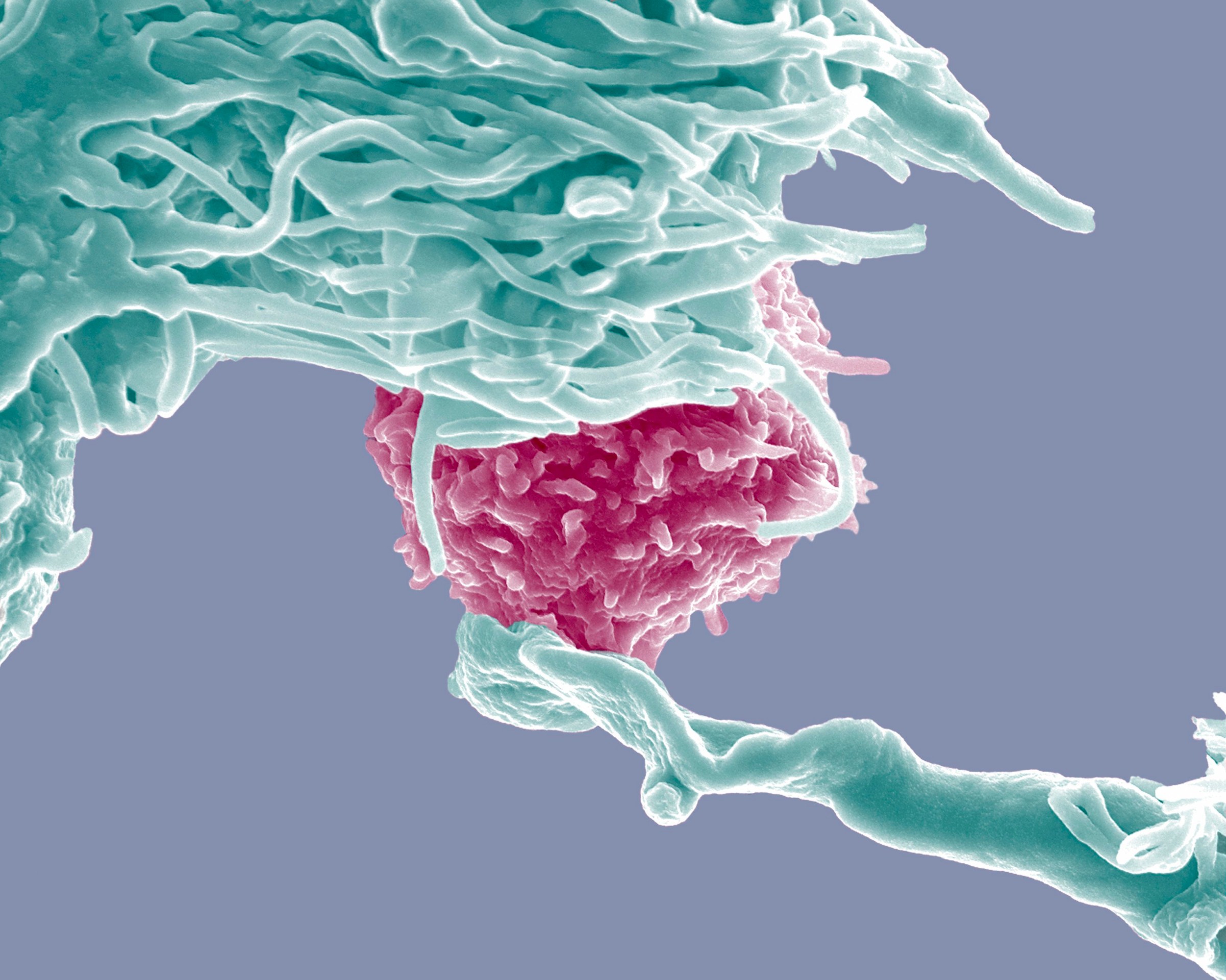
T cell (pink) interacts with a dendritic cell (blue), which captures antigens and presents them to T cells. Some activated T cells develop into long-lived memory cells that retain the ability to recognise the same antigen. Colourised scanning electron micrograph (SEM).
LMU immunologist Dr. Reinhard Obst explores these questions. As the leader of a research group at the Biomedical Center’s Institute for Immunology, Obst investigates how specific signals shape the development and behavior of T cells. Together, memory B cells and memory T cells form the backbone of our immunological memory. While memory B cells rapidly produce antibodies upon renewed contact with a pathogen, memory T cells can instantly activate the overall immune response and eliminate infected cells.
“Immunological memory is based on cell properties,” Obst emphasizes, and is therefore fundamentally measurable. Nevertheless, it remains unknown why immunity against some pathogens can last a lifetime – while it fails to do so for others. The vaccines against smallpox and yellow fever viruses remain the gold standard to this day, notes Obst. Even decades after immunization, specific antibodies and T cells can still be detected in the body. By contrast, other immunizations, such as the tetanus shot and modern mRNA vaccines against Covid-19, require regular booster shots.
How the immune response gets going
An immune response must be fast and effective at first – and then transform into a lifelong state. “We differentiate between the first effector phase, which lasts from days to weeks, and a memory phase, which can last for years,” says the immunologist. When a pathogen appears on the scene, the response must be rapid. Although there are billions of naïve – that is, not yet activated – T cells circulating in the body, only a small proportion of them – Obst cites 0.0001 to 0.01 percent – possess the right receptor to recognize precisely this pathogen via certain protein fragments known as antigens.
»We differentiate between the first effector phase, which lasts from days to weeks, and a memory phase, which can last for years.«
Reinhard Obst, Research Group Leader at the Institute of Immunology
These cells are activated, increase their size fivefold, switch on thousands of genes, and after 24 hours begin to divide. “And they do so at the highest rate of any cells in the adult organism – three times a day,” Obst remarks. In this way, a vast armada of effector T cells is produced in a matter of days. “With the Covid vaccination, we saw that it took around 10-14 days until immunity could be demonstrated,” explains Obst, who himself was involved in the early days of mRNA technology 25 years ago during his doctoral studies with Hans-Georg Rammensee in Tübingen.
From activation to memory cell: what we know and what we don’t
When the immune response subsides, most of the effector T cells die. This ‘crash’ is necessary: if it fails to occur, chronic inflammation and autoimmune disorders may ensue. A small population remains and transitions into the memory phase as long-lived cells. In this phase the cells are able to be reactivated within a few hours, not days, of renewed contact with the antigen.
“Immunological memory is based on cell properties,” emphasizes immunologist Reinhard Obst from LMU's Biomedical Center (BMC).
But what decides which cells become memory cells? Immunology has various models, but no definitive answer. According to the early-split model, the decision is made at a very early stage – “perhaps as early as the first cell division,” says Obst, “possibly triggered by an asymmetric distribution of nutrients, proteins, or organelles to the daughter cells.” According to the linear model, all cells are initially effector cells; only later do some of them progress to memory cells. There is supporting evidence for both models. “Like the proverbial blind men feeling an elephant, researchers worldwide are trying to elucidate this important question,” chuckles Obst. These simplified models tend to be quite schematic at first. Past experience has frequently shown, however, that although the models may not be fully correct, they prompt better experiments.
T cells can burn out
Correct development into a memory cell is also generally contingent on the antigen disappearing again after some time. If it remains present, T cells can suffer ‘burnout’ and lose functions. Obst was able to demonstrate how sensitively T cells respond to the strength and duration of antigen signals for so-called helper T cells, the largest subgroup of T cells. These T cells are very flexible and therefore, in Obst’s view, “perhaps the smartest cells of the immune systems.” They coordinate the immune response by activating other immune cells and regulating their function with the help of messenger substances.
“For our experiments, we used a mouse model that I developed during my postdoc period at Harvard using tools from Hermann Bujard in Heidelberg,” explains Obst. “By adjusting the amount of the antibiotic doxycycline in the mice’s drinking water, we can control how much antigen is presented to their T cells and for how long.”
Antigen quantity determines the development of memory T cells
The experiments revealed that the more antigen present, the faster the T cells divided. Their subsequent development also depended on the duration of exposure: If the antigen was removed after a few days, memory cells formed during the immune response such as we would expect, for instance, after a vaccination. If antigen levels remained high, however, the cells became exhausted over time – and the higher the antigen load, the more quickly this occurred. When antigen quantities stayed very high for a prolonged period, the cells even died.
»We were truly amazed to discover that there are genes that can read the antigen quantity.«
Reinhard Obst, Research Group Leader at the Institute of Immunology
To Obst’s surprise, the helper T cells not only recognized whether an antigen was present, but also how much of it. Genetic analyses showed that some genes were active only in memory cells, while others were switched on only under a strong and lasting antigen load. In some cases, moreover, activity differed according to whether the T cells were exposed to a small, medium, or large amount of antigen. “We were truly amazed to discover that there are genes that can read the antigen quantity.”
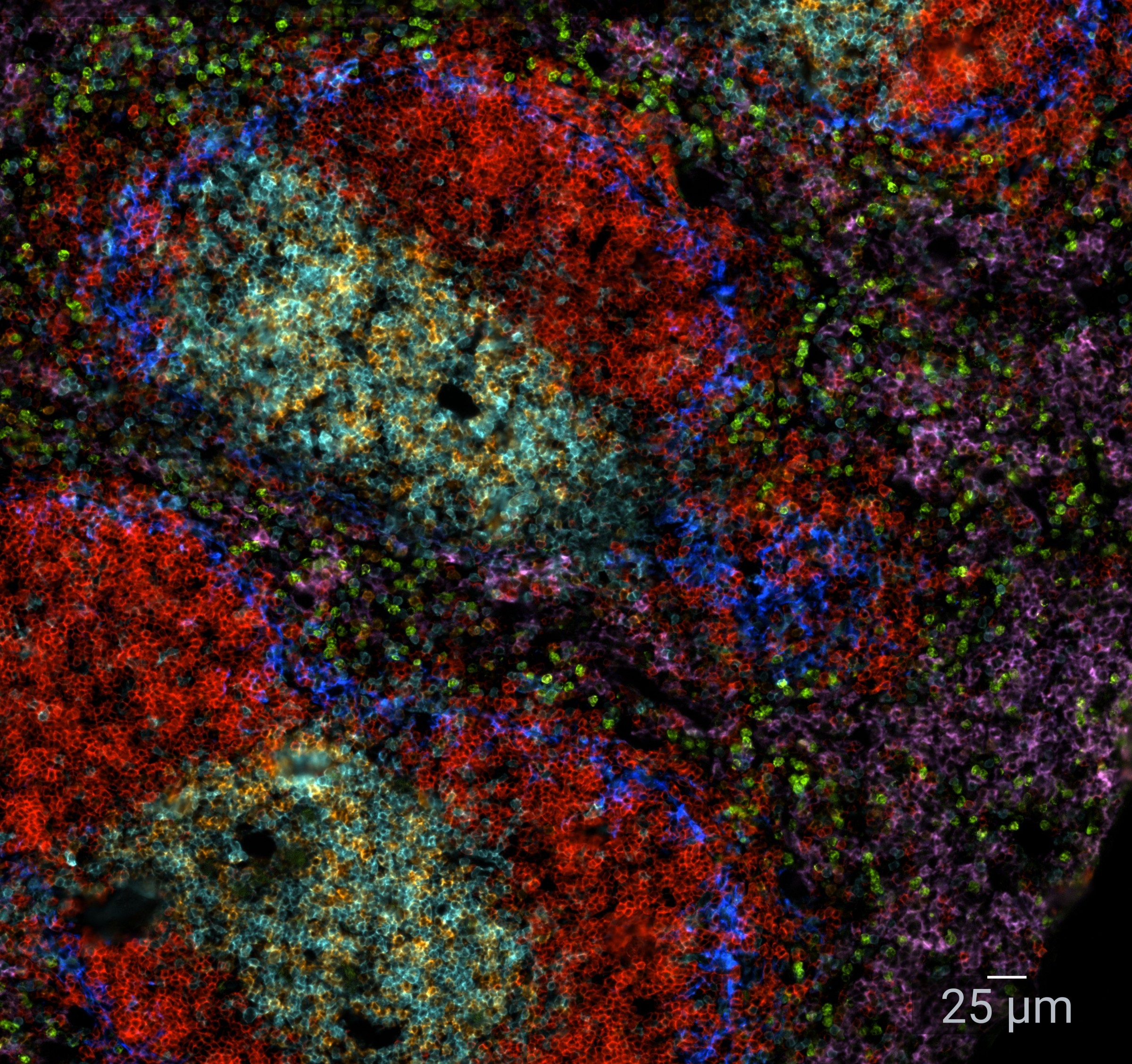
Histological image showing the spatial distribution of immune cells across different compartments of the spleen of a healthy mouse. This organisation enables targeted interactions between immune cells and helps initiate a specific immune response. How the immune response develops also depends on the antigen signals to which T cells are exposed. Light blue: T helper cells; orange: cytotoxic T cells; red: B cells. Blue, light green and pink: other types of immune cells.
Immunological exhaustion: the flipside of immunological memory
The immunologist was particularly interested to find that the state of exhaustion was at least partially reversible when the antigen was removed. Exhaustion is therefore not the same as forgetting: The cells retain something of their original priming and can be reactivated. “Our experiments have shown a remarkable plasticity in helper T cells,” emphasizes Obst. In the case of killer T cells, another subgroup of T cells that play a particular role in combating viral infections, it is a different story: "Another puzzle ...” Obst remarks.
T cell exhaustion certainly has its purpose from a medical perspective. As Obst explains, it is an immunological tolerance mechanism and prevents an immune response from lasting too long or turning against the body’s own tissues. On the other hand, it can have drawbacks when it comes to fighting cancer or chronic infections. Therapeutically, this brake can be released by antibodies directed against a central molecular switch. Such ‘checkpoint’ antibodies are already being used to treat some cancers, observes Obst. Conversely, some researchers are trying to deliberately activate this molecular switch to curb excessive immune reactions.
»Our experiments have shown a remarkable plasticity in helper T cells.«
Reinhard Obst
As numerous molecular switches regulate the exhaustion of T cells, there might be other therapeutic avenues available. But researchers are still trying to determine which ones specifically could serve this purpose. Furthermore, the system has proven to be unexpectedly complex: The protein TOX is thought to be a sort of ‘master switch’ for T-cell exhaustion in killer T cells. In recent studies, however, Obst and others have found that TOX “plays hardly any role” in helper T cells. “This surprised us,” he says.
Another open question is how the differentiation of long-lived memory cells could be specifically enhanced. Intervening in their genetic program would be complex, cautions Obst, as the immune system is built on diversity. The way the immune system works, only a small number of T cells are supposed to be specialized for any given antigen. Any artificial reprogramming would have to preserve this diversity and must not homogenize all the cells.
“To date, vaccination has remained the only means of getting the body to form specific memory cells,” says Obst. The major challenge lies in understanding the underlying mechanisms so well that it becomes possible to improve the duration and quality of this immune response. “If one day somebody were to find out how to make, say, a tetanus or mRNA vaccine for a one-time inoculation with lifelong protection, that could well be worth a Nobel Prize.”
PD Dr. Reinhard Obst heads a research group at the Biomedical Center’s Institute for Immunology.
Text by Monika Gödde
More from LMU's research magazine:
The rhythm of life: Axel Imhof studies how epigenetics regulate processes within the cell, preserve a molecular memory after division – while still allowing flexibility. Read now!
Lost in the Mediterranean: “What happens to those who do not survive the crossing?” Anthropologist Gerhild Perl researches how relatives and societies deal with these disappearances. Read now!